
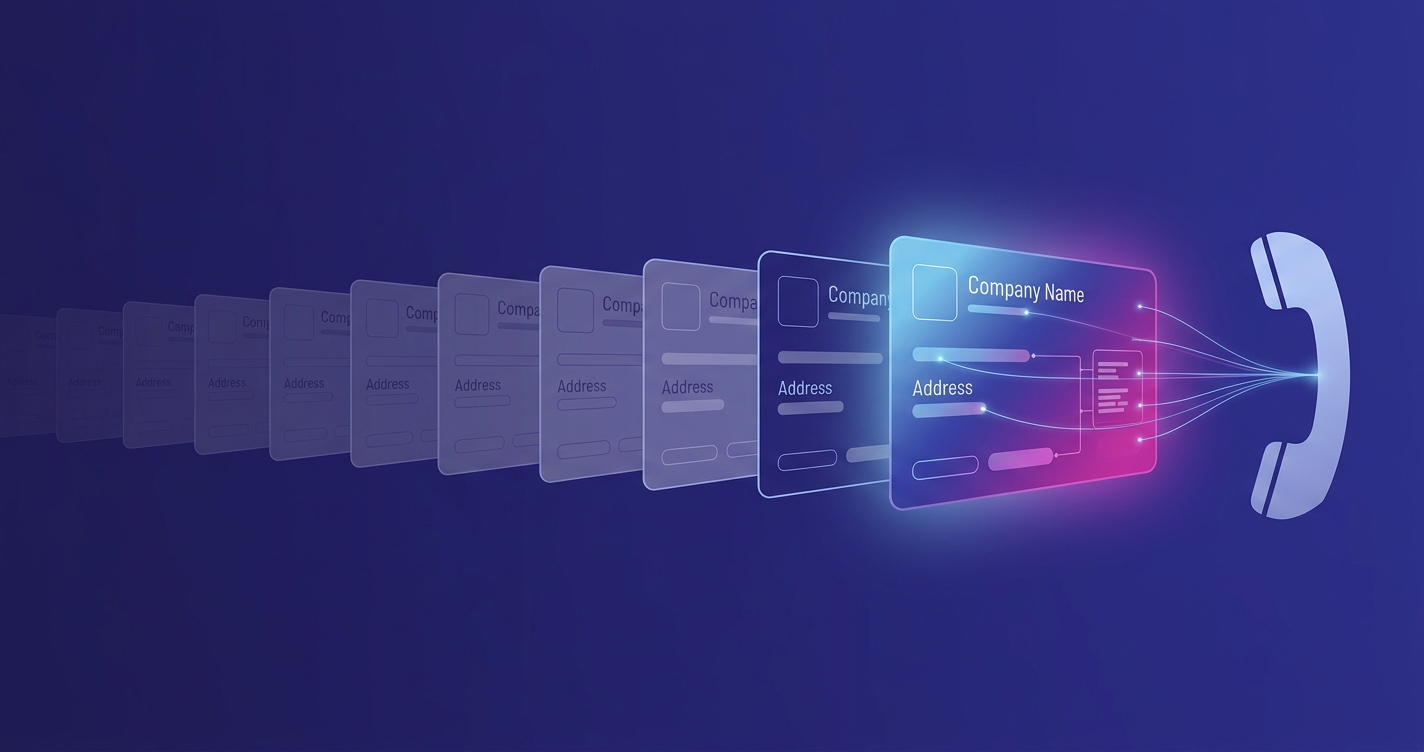
Your telemarketer has eighty names in front of her and a target of getting through them by Thursday. For each one she has a company name, a phone number, and a sector tag. That is the list. That is what she dials against, name after name, until something turns into a conversation.
What she does not have is any sense of whether those eighty names were worth dialling in the first place. She does not know which are the right size to buy what she sells. She does not know which renewed a three-year contract last quarter and won't move for another two and a half years. And — calling about fibre and hosted voice — she does not know whether the product she's pitching is even available at the address she's about to ring.
She dials anyway. That is the job, and everyone on the floor does it the same way.
The Numbers-Game Defence
Every reseller running an outbound team knows this floor. The dial counts are healthy, the telemarketers are working hard, and a large share of those dials were never going to land — for reasons that were knowable before the phone rang.
Ask why the floor runs this way and the answer is some version of the same thing: cold outbound is a numbers game. You can't know what's happening inside an account before you call it, so you call more of them. Volume covers the misses. Dial enough and the sits come.
There is real truth in that. A former telecoms salesperson put it to me plainly last week: getting past the gatekeeper and working out what's going on inside an account when nobody will talk to you is the hardest part of the whole job, and no tool fully solves it. He's right. That part is hard, and nothing here changes it.
But "numbers game" does a quiet bit of work in that sentence. It takes the fact that a chunk of every list was dead on arrival and reframes it as the natural cost of outbound — something to dial through rather than something to fix.
The Dead Dial
A dial is dead when it was never going to convert no matter how good the telemarketer is. On a reseller's floor, dead dials cluster into three shapes, and all three are visible before anyone picks up the phone.
The first is the channel's own, and it's the one no other industry's sales floor has to think about: the product isn't available at the site. A telemarketer pitching FTTP to an address that can only take FTTC is selling something that doesn't exist there. The pitch is wrong from the opening sentence, and no amount of skill on the call recovers it. Checking properly means logging into the carrier portal, entering the postcode, and reading what's actually serviceable — for every name on a list of eighty. Nobody does that before they dial; there isn't time. So the dial goes out blind, and now and then the whole conversation is built on a product the prospect was never going to be able to buy. It is the hardest of the three to see from the list, and the easiest to settle in advance.
The other two are more familiar. The account is the wrong size — below a certain headcount the deal is too small to be worth the meeting; above a certain size there's an account manager somewhere and a procurement process the floor can't shortcut. A name on a list carries none of that. Companies House does.
And there is no contract pressure. A business that signed a three-year agreement eight months ago is not switching, however good the pitch. The trigger — a contract approaching its end, a recent funding round, a director change, fresh filings — is what separates an account that's ready from one that's wasting the dial. That signal sits in public data; it just isn't next to the phone number.
None of these are gatekeeper problems. They are targeting problems, and targeting is done before the call, not during it.
What the Floor Actually Costs
Put numbers on it. A telemarketer working the phones makes somewhere around 55 dials a day — 1,100 a month across twenty working days. A floor of four is 4,400 dials a month, just under 52,800 a year.
Now assume three in ten of those land on accounts that were dead before the dial: wrong size, no contract pressure, or no serviceable product at the address. For an unfiltered list, that is not a pessimistic figure. Three in ten of 52,800 is roughly 15,800 dials a year aimed at ground that could have been ruled out in advance.
Each attempt — looking up the name, dialling, waiting, getting through a gatekeeper or a voicemail, logging the note — runs a few minutes even when nothing comes of it. At three minutes apiece, 15,800 dead dials is around 790 hours a year. At a fully-loaded telemarketer cost of about £20 an hour, that is close to £16,000 a year of outbound effort spent dialling accounts that were never going to convert.
That £16,000 is the visible cost, and it is the smaller one. The larger cost is what those 790 hours could have been. Pointed at accounts that fit the size band, sit inside a buying window, and can actually take the product, the same hours produce conversations with a different hit rate — because the telemarketer is reaching businesses that can say yes. On a floor paid per qualified sit, that difference runs straight through the pipeline. The dialling didn't change. The list did.
Narrowing the Guesswork
This is where the honest limit matters. None of this gets a telemarketer past a determined gatekeeper, and it will not tell them what the finance director is thinking. The part of the job that is hard stays hard. What it does is narrow the guesswork — which is exactly what the salesperson I spoke to said good intel does.
It does two specific things. It makes sure the dial is going somewhere worth the call: right size, real trigger, serviceable address. And it puts one true, specific thing in front of the telemarketer before they dial — that this business's contract is up in four months, that they've grown from twelve to twenty-eight staff in two years, that fibre is live at their site — so the opening line lands as relevant rather than as a script. In the few seconds a gatekeeper takes to decide whether to put a call through, relevance is the only thing that moves the odds.
The information to do both already exists before the dial. Companies House holds the size, the directors, the filings. Apollo — a prospect-data platform a sales team can pull firmographics and contacts from — holds the rest. And the carrier portal holds the one answer that decides whether the product is sellable at that address at all. The only reason none of it is in front of the telemarketer is that pulling it together for every name on a list is hours of work nobody has. So it doesn't happen, and the floor dials blind instead.
That assembly is the whole problem, and it is the one part of the process that does not need a person doing it. The postcode already on the record can be run through the carrier's availability check automatically. The company name can return its size band, its recent filings, and its director changes before the telemarketer reaches it on the list. The serviceability answer — the one that takes a portal login per address by hand — can be sitting in the record by the time the name comes up. What's left for the telemarketer is the dial that was worth making, with something relevant to open on.
The Point
A telemarketer dialling a dead account is not working badly. They are working exactly as instructed, against a list that was handed to them blind. The numbers game isn't a strategy — it's what you're left with when the targeting was never done.
You can't beat every gatekeeper. You can stop paying your floor to dial accounts that were never going to convert, and you can make sure that when they do get through, they have something relevant to say. The resellers already doing this aren't dialling more than their competitors. They're dialling better, and it shows up in the only number that matters: sits booked per hour on the phones.
If your telemarketing floor is working off lists with nothing on them but a name and a number, the UK Telecoms Reseller Ops Benchmark is built to surface exactly this kind of gap — and the output is yours to keep.
Download the UK Telecoms Reseller Ops Benchmark: https://aideal.group/benchmark