"We've looked at a few automation tools. They're not built for how we work."
It's one of the most common things we hear from business owners. And it's completely understandable. You've sat through a demo, watched someone click through a polished interface, and thought: this would work for a generic business. We're not a generic business.
You've got pricing logic that depends on three factors nobody else cares about. Approval workflows that reflect years of hard-won operational lessons. Client communication preferences baked in from relationships that predate your current software stack by a decade.
Cookie-cutter doesn't fit. And you know it.
You're Right — And That's Exactly the Problem With the Wrong Approach
The fear is legitimate. Off-the-shelf automation platforms promise a drag-and-drop future where anyone can "connect their tools in minutes." And sometimes, for simple tasks, that's true.
But here's what those platforms don't tell you: they're built for the average. The average invoice. The average lead. The average approval process. The moment your business logic deviates from the average — and most businesses above £500K revenue have already deviated significantly — those platforms start asking you to reshape your operations to fit their software.
That's not automation. That's conforming.
Sarah, an operations manager at a mid-sized electrical installation firm, described it well. "We tried one of the big platforms. The problem wasn't the tools. It was that the tool wanted us to do things its way. Our quoting logic has five variables that depend on site conditions, access restrictions, and supplier availability. The platform couldn't handle that without hacks everywhere."
She's not describing a problem with automation. She's describing a problem with standardised automation applied to non-standard logic.
Here is the flip that most business owners miss: your uniqueness isn't the obstacle. It's the specification.
The fact that your business has unusual logic isn't a reason to avoid automation. It's the exact input that makes bespoke automation work. Your specific rules, your specific variables, your specific workflows — those aren't complications. They're the brief.
1. The Lego Block Method
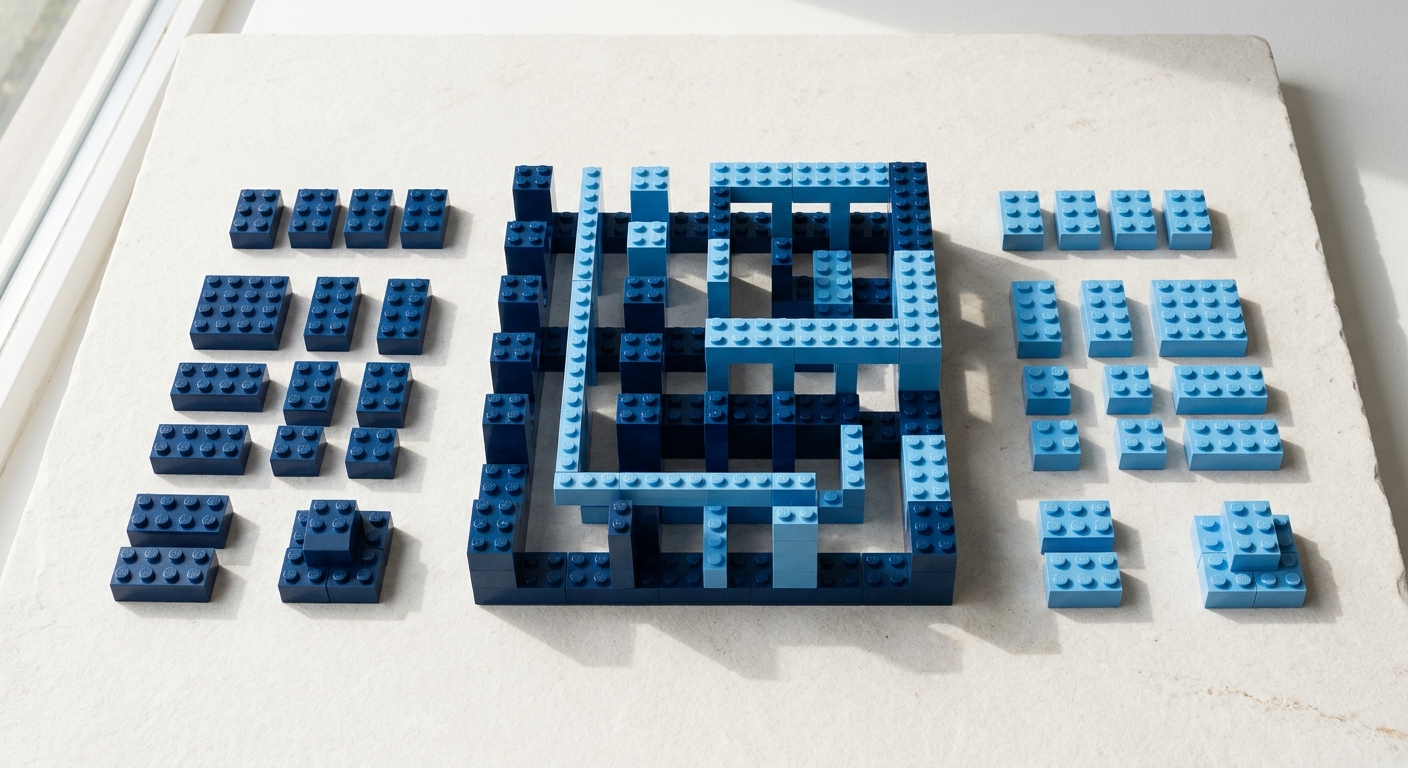
Think about how Lego works. The individual bricks are completely standard. Universal. Identical in their engineering. But what you build with them is entirely yours.
Modern automation works the same way.
The underlying building blocks — the connections between your tools, the databases that store your information, the AI systems that process language and data — are standard. They exist. They work. They've been tested by millions of processes across thousands of industries.
What sits on top of them is yours.
Your pricing logic goes in. Your approval thresholds go in. Your customer communication rules go in. Your compliance requirements go in. The blocks are standard. The structure they form is unique to how your business actually operates.
This is what separates genuine bespoke automation from off-the-shelf tools wearing a costume. It's not about reinventing the technology. It's about applying standard, proven technology to your specific rules.
The result: an automation that behaves like someone who has worked in your business for years and knows exactly how you do things — because it was built from that knowledge.
2. The Cost of "It Won't Work for Us"
Here's the calculation most businesses never run.
Take a process that your team handles manually because "it's too complex to automate." Let's say it's quoting for a specialist trades business. Three variables: labour rate by engineer seniority, materials markup by supplier tier, and a site-access multiplier based on location type.
Sounds complicated. But let's put a number on it.
One office manager. 25 quotes per week. 90 minutes per quote (because of the complexity). That's 37.5 hours per week. At a fully-loaded employer cost of £25/hour, that's £48,750 per year to produce quotes manually.
Now: all three of those variables can be mapped. They can be codified. They can be built into logic that runs automatically. The quote still reflects your specific rules — it just doesn't require a person to calculate it every time.
The cost of the automation build: £4,000–£8,000 depending on scope.
Payback: under 8 weeks.
The "it's too complex" objection didn't protect this business from waste. It cost them nearly £50,000 a year.
3. The Three Questions That Build the Specification
The way bespoke automation actually starts isn't with a technology conversation. It starts with three questions.
Question 1: What decision is being made?
Not "what task is being performed." What decision. When your office manager builds a quote, they are making a series of decisions: which rate applies, which supplier to price from, what margin to apply, whether a site survey is needed first.
Every decision is a rule. Every rule can be mapped.
Question 2: What are the conditions that change the outcome?
This is where most businesses think their complexity is disqualifying. It's actually the opposite. Conditions are the specification. If the answer changes based on whether the client is commercial or residential, that's a condition. If the approval route changes based on deal value, that's a condition. These aren't complications — they're the architecture of the automation.
Question 3: Where does the information come from and where does it need to go?
Which systems hold the data the decision needs? Where does the output need to land — a PDF, a CRM record, a Slack message, an email? This maps the connections. Again, the connections are standard. The specific data flowing through them is yours.
Answer those three questions for any process in your business and you have the specification for a bespoke automation. Not a template. A brief.
4. What "Bespoke" Actually Costs (And What It Saves)
There is a misconception that bespoke means expensive. It often means the opposite.
When you use off-the-shelf automation and spend months trying to make it fit your business — paying for licences, internal time, failed workarounds, and eventual rebuild costs — the price climbs fast. It's a slow bleed. Hard to see on any single invoice.
Bespoke automation has a clear, fixed cost upfront. You know what you're getting. You own it outright. No ongoing subscription to the tool that built it. No dependency on a vendor who might change their pricing or shut down the feature you relied on.
The Old Way: → Trial off-the-shelf tool → Spend weeks configuring workarounds → Automation breaks when your process changes → Pay licence fees indefinitely → Process still partially manual because tool couldn't handle the edge cases
The New Way: → Map your actual business rules → Build automation to those rules using standard technology → Automation adapts because the logic is yours to update → No ongoing licence to the automation itself → Process fully automated, edge cases included
Result: lower total cost, higher reliability, and no vendor dependency.
Summary
Your business being unique is not a reason to avoid automation. It is the reason to do it properly.
The tools are standard. The logic is yours. Bespoke automation isn't expensive or complicated — it means someone took the time to understand how your business actually makes decisions and built the automation to match.
The businesses winning in the next five years aren't the ones who squeezed themselves into generic software. They're the ones who built automation that reflects how they actually work — and compounded the efficiency from that point forward.
If you've read this and thought "we have processes that are too complex for off-the-shelf tools," that's exactly what the free AI Opportunity Audit is designed to address.
We map your processes, identify the logic, and tell you whether bespoke automation makes financial sense — with a clear ROI calculation before you spend a penny.
Book your free Audit here: www.aideal.group
Thanks for reading!