
When Claire handed in her notice, the MD's first thought wasn't about finding a replacement.
It was about the knowledge walking out with her.
Twelve years at the company. Every carrier escalation path memorised. The specific contact at Gamma for when a broadband order goes silent after day five. The workaround for porting confirmations that arrive in the wrong format. The three customer accounts that always need handling differently because of configurations agreed before the CRM existed. The subject line patterns that distinguish a TruSip completion from a rejection before you've even opened the email.
None of it written down. All of it in her head. And three months' notice to extract a decade of operational knowledge before it left the building.
Every reseller MD knows a version of this story. Some have lived it. Others can name the person whose departure would cause the same problem right now.
The uncomfortable truth is that tribal knowledge is not a new problem or an overlooked one. Most MDs know it exists. Most have, at some point, made a note to do something about it. What they have not done is fix it — because the traditional fix is genuinely impractical.
Documenting operational knowledge properly means sitting down with the person who holds it, mapping every process they run, writing it all up, and maintaining it as the business changes. It requires dedicated time from the busiest person in the operation. It requires someone to own the documentation and keep it current. And it requires the business to pause long enough to do it properly.
None of those conditions are ever simultaneously true in a reseller running at capacity. So it doesn't happen.
But here is what that framing gets wrong: the knowledge was never only in Claire's head.
Every time she processed a supplier email, she applied logic. Every time she handled an exception, she followed a pattern — one developed over years of seeing what works and what doesn't. Every time she knew to escalate to a specific contact rather than the general helpline, that decision left a trace — in the email she sent, the note she added to the CRM record, the outcome that followed.
The operational knowledge of the business has been expressed, continuously, through every piece of work that has ever been done in it. It exists in the email history. It exists in the CRM notes. It exists in the pattern of how exceptions get handled and how resolutions get reached.
It was never missing. It was just unstructured — stored in a form that requires Claire to be present to access it.
The Difference Between Knowledge and Documentation
The reason process documentation fails is not that the knowledge doesn't exist. It is that writing a document is a separate activity from doing the work.
It requires someone to stop, reflect, translate what they do into written instructions, and maintain those instructions as the process changes. That task sits permanently at the bottom of the priority list because the operational work is always more urgent. The document either never gets written, or gets written once and drifts out of date within months.
The insight that changes this is simple: the documentation and the work do not have to be separate activities.
Every supplier email processed, every exception resolved, every decision made in the course of normal operations is itself a form of documentation — raw, unstructured, but rich with the logic that drives the business. The question is not how to get the team to write things down. It is how to read what they have already been writing.
What AI Reading Operational Communications Actually Does
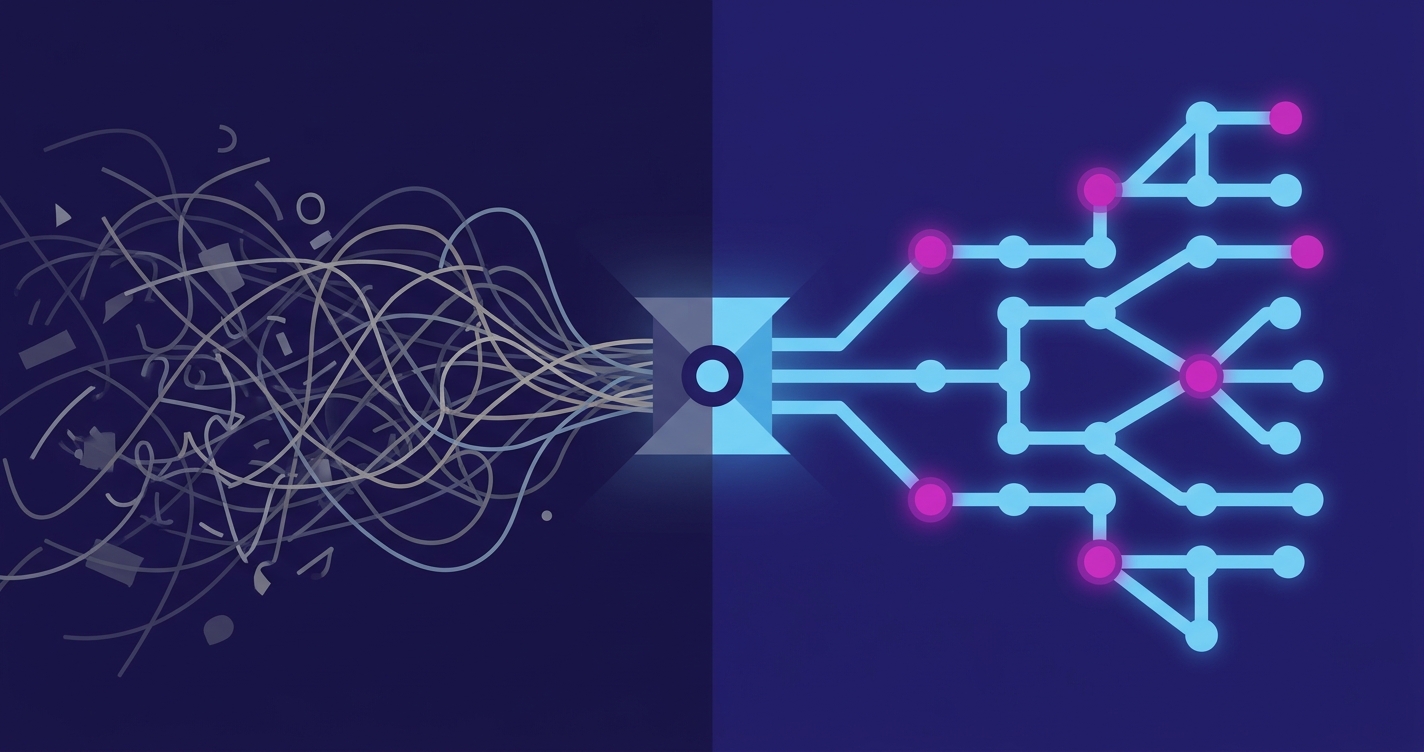
An AI system trained to read operational communications — supplier emails, CRM notes, exception logs — does not replace the coordinator. It reads what the coordinator has already produced and surfaces the patterns within it.
Over time, it identifies which suppliers send which types of updates and in what format. It recognises which order types follow which resolution path. It captures the logic behind escalation decisions — not from an interview with Claire, but from the thousands of emails where that logic was applied. It builds a picture of how the operation actually runs, drawn from the evidence of how it has actually run.
The result is not a process document. It is something more useful — a knowledge base that reflects real operational practice rather than an idealised version of it, maintained by ongoing activity rather than manual updates, and accessible without requiring the person who holds it to be present.
When a new coordinator joins, they are not relying on memory passed down in handover notes. They are querying a knowledge base built from years of actual work.
When an exception arrives that nobody has seen before, the response is informed by every similar exception the business has ever handled — not just the ones the current team member remembers.
When Claire leaves, the knowledge does not leave with her. It has already been captured — not by asking her to write it down, but by reading what she was already writing every day.
A Living Record, Not a Static Document
The other failure mode of traditional documentation is obsolescence. A process written down in January is out of date by March. Carriers change their portals. Suppliers update their processes. New order types emerge. The document that was accurate when it was written quietly becomes a liability — giving a new team member confidence in instructions that no longer apply.
A knowledge base built from live operational activity does not have this problem. When a carrier changes their confirmation email format, the new format gets processed. The pattern updates. When a new supplier comes on board and the first exceptions get handled, those handling decisions become part of the knowledge base. The record stays current because it is fed by the work itself.
This is the meaningful difference between a process document and an operationally-grounded knowledge base. One is a snapshot. The other is a living record.
Summary
The operational knowledge that makes a reseller function — which supplier to escalate to, which process applies to which order type, what to do when something goes wrong — has always been documented. It just has not been readable.
It exists in every email processed, every exception handled, every decision made over years of operations. The business has been writing it continuously. The problem has never been that the knowledge does not exist. It is that nothing has been reading it.
AI systems that capture operational knowledge passively — from the communications and activity that already exist — change the nature of the problem. The question is no longer how to get a busy team to stop and write everything down. It is how to surface what they have already been expressing every day.
If operational knowledge, process documentation, or the risk of key-person dependency is something you are carrying in your reseller business, the Reseller Ops Roadmap is the right starting point. Fixed scope, fixed fee, and the output is yours.
Book a Roadmap conversation: https://aideal.group/benchmark
Thanks for reading!