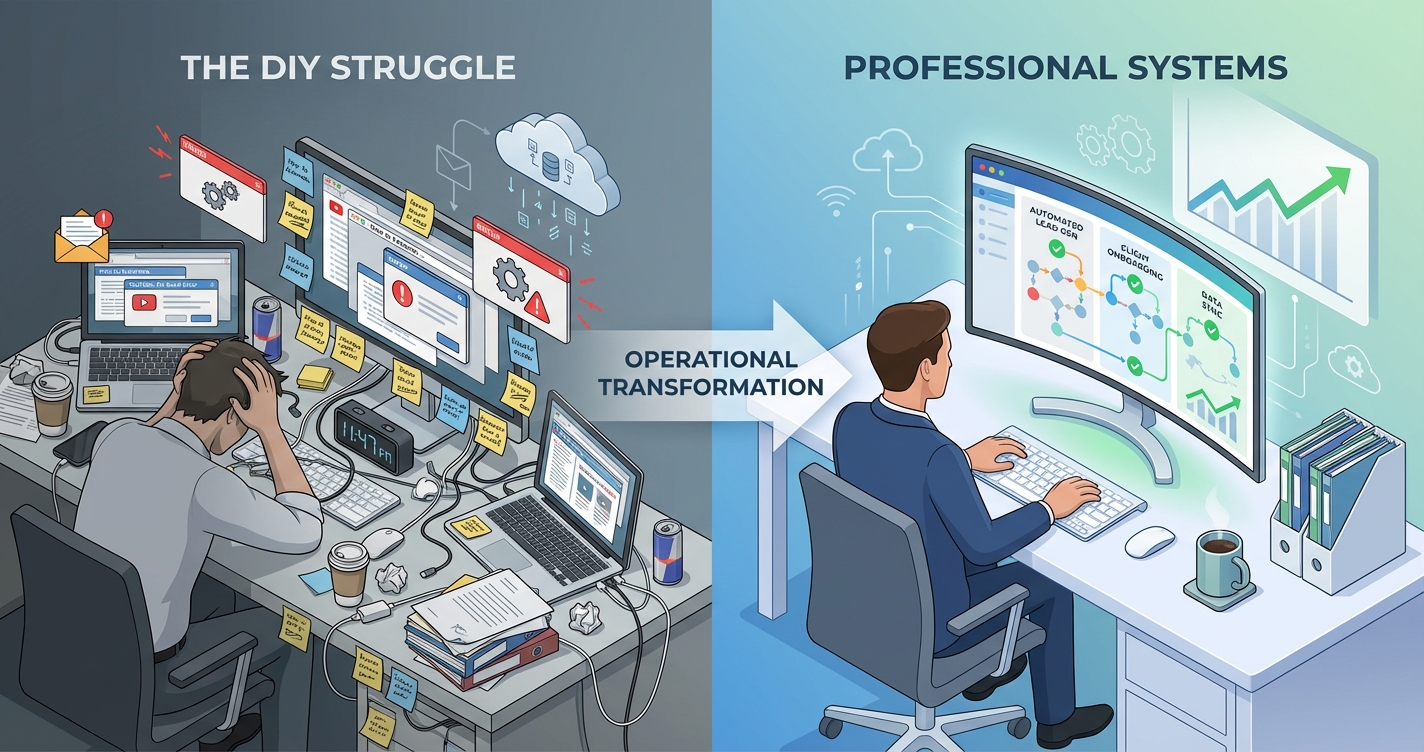
Dave from Operations is watching a YouTube video titled "Zapier Tutorial for Beginners - Automate ANYTHING in 10 Minutes!"
He is taking notes. He is nodding along. He is thinking: "This actually looks quite straightforward."
Meanwhile, you are looking at a £5,000 quote from an automation consultant and thinking: "Dave is smart. He is technical. Why am I paying someone else to do something Dave could learn in a weekend?"
So you make the call. "Dave, have a crack at this. See what you can do."
Dave is thrilled. This is interesting work. It is a break from the usual grind. He dives in.
Six months later:
- Dave has built 15 workflows. Twelve of them work. Three break intermittently, and no one knows why.
- Your critical lead routing system is "70% done" but keeps dropping enquiries into a black hole.
- Dave is stressed. He is spending 15 hours a week troubleshooting instead of doing his actual job.
- Your operations are slower than before you started.
- You have just received a quote to "untangle and rebuild" everything Dave built. It is £8,000.
You did not save money. You lost it. Along with six months of momentum, Dave's sanity, and a chunk of your market share.
Here is why the "Dave will figure it out" approach almost always fails—and when it actually makes sense.
The False Economy: Dave's Time Is Not Free
Let's run the numbers properly.
Dave earns £40,000 a year. But that is not what he costs you.
Your actual cost includes Employer's National Insurance, pension contributions, software licences, equipment, office overheads, and management time. A staff member with a £40k salary actually costs the business closer to £50k–£55k per year.
Furthermore, no human works 8 hours a day productively. Between coffee breaks, meetings, and context switching, the average productive time is around 5-6 hours.
The Math:
If a "fully loaded" employee costs you £52,500 and works 1,600 productive hours a year, their time is worth roughly £32.80 per hour.
Over six months, Dave spends 200 hours learning Zapier, building workflows, and troubleshooting failures.
200 hours × £32.80 = £6,560 in real cost.
But that is not the real cost.
The real cost is opportunity cost.
What was Dave not doing during those 200 hours?
- Optimizing your supply chain.
- Fixing bottlenecks in dispatch.
- Training the new hire.
- Solving the recurring issue with your returns process.
Dave's job is to make operations run smoothly. Every hour he spends on YouTube University learning Python is an hour your operations are running at 80% efficiency.
The consultant's £5,000 fee? It bought you a working system in four weeks, delivered by someone who has built this 50 times before, with documentation, with training, and with a guarantee that it works.
Dave's "free" approach? It cost you £6,560 in real salary cost, six months of lost productivity, and a broken system you now have to pay someone else to fix.
You did not save money. You just hid the cost in a place you were not measuring.
Every time Dave spends an hour troubleshooting a broken Zapier workflow, you are effectively burning a £30 note.
The Plumber's Boiler Problem
You could learn to fix your own boiler.
There are YouTube videos. There are manuals. It is not rocket science.
But you do not do it. Why?
Because your time is worth more than the plumber's hourly rate. You could spend 8 hours figuring out how to bleed a radiator, or you could spend 8 hours running your business while the plumber does it in 45 minutes.
Automation is your business's boiler.
Yes, Dave could learn to build it. But while he is learning, your competitor has already deployed a working system and is capturing the leads you are still manually processing.
Speed is not a luxury. It is a competitive advantage.
The DIY Line: When It Makes Sense (And When It Doesn't)
Let's be clear: Not all automation requires a consultant.
There is a line. On one side, DIY is fine. On the other, it is reckless.
Green Light for DIY:
- Simple, single-tool automations. (Gmail → Slack notification when a form is submitted.)
- Non-critical "nice to haves." If it breaks, nothing catches fire.
- Dave genuinely has slack time and wants to learn for professional development.
- Low complexity. Two steps, no branching logic, no error handling required.
If the automation fits this description, go for it. It is a good learning opportunity and low risk.
Red Light for DIY:
- Critical business operations. (Invoicing, lead routing, customer onboarding.)
- Multi-tool integrations. (CRM + accounting software + email + project management.)
- Anything requiring conditional logic, error handling, or data validation.
- Systems where failure has a business impact. (Lost revenue, angry customers, compliance risk.)
Here is the trap most businesses fall into:
They start with a simple automation. It works. Dave feels confident.
So they give him a bigger one. Then a bigger one.
By the time they realize Dave is in over his head, they have 15 half-working workflows and no clear way to untangle them.
The Beginner-Friendly Platform Trap
Zapier and Make.com are popular because they are easy to use. Drag, drop, click. You can build something in 10 minutes.
But here is what no one tells you:
The easier the platform, the lower the ceiling.
Zapier is brilliant for simple automations. But the moment you need advanced logic, custom API calls, or complex data transformations, you hit a wall.
At that point, you have two options:
- Rebuild everything in a more powerful platform (like n8n or custom code). This means starting from scratch.
- Hire someone to work around Zapier's limitations. This is expensive and inefficient.
Most businesses discover the ceiling after they have built 20 workflows they now cannot migrate.
Dave does not know where the ceiling is until he hits his head on it.
The "£50 Tool That Cost £50,000"
Here is a real scenario (details anonymized):
A logistics company wanted to automate their lead intake process.
- Leads came in via website form.
- They needed to be triaged, routed to the right salesperson, and logged in the CRM.
- Follow-up emails needed to be sent automatically.
The owner asked Dave from Ops to "have a go."
Dave bought Zapier Pro (£50/month). He watched tutorials. He started building.
Four months later:
- Dave had built 15 workflows.
- Most of them worked.
- The critical one—lead routing—was "70% done."
- The problem: It needed conditional logic based on custom CRM fields. Zapier could not handle it cleanly.
Dave spent three weeks trying to make it work. He failed.
The owner hired a consultant to "finish it."
The consultant's assessment:
"This is unmaintainable. The logic is brittle. There is no error handling. If one thing breaks, the whole system fails silently. We need to rebuild it properly."
Final cost:
- £8,000 to rebuild.
- Six months of lost leads (estimated value: £30,000+).
- Dave's 200+ hours (£6,560 in real salary cost).
- Team morale hit from "Dave's thing that never worked."
Total cost of the "£50 tool": Over £44,000.
If they had hired properly from the start, it would have cost £5,000 and been live in four weeks.
The Hidden Third Option: Partner to Build, Then Own
Most business owners think it is binary:
- Option A: Build it ourselves (DIY).
- Option B: Hire someone and pay them forever (vendor lock-in).
Both options feel bad. DIY is risky. Vendor lock-in is expensive.
But there is a third option most people do not consider:
Partner with a specialist to build it, then own and maintain it yourself.
Here is how it works:
- Hire a specialist to build the system in your accounts, with your API keys.
- They deliver a working system, full documentation, and training for your team.
- You own it. The specialist has no ongoing control. You can fire them tomorrow and the system keeps running.
- Dave shadows the build. He learns from a pro. He asks questions.
- Once it is live, Dave handles simple maintenance (changing an email template, adjusting a trigger time).
- For complex changes or troubleshooting, you call the specialist back (optional, not mandatory).
This way:
- You get speed (live in weeks, not months).
- You get quality (built by someone who has done it 50 times).
- You retain ownership (no golden handcuffs).
- Dave gains real skills (learning from a professional, not trial-and-error).
But only if the engagement is structured correctly:
- Fixed-price or outcome-based pricing (not open-ended hourly).
- 100% IP ownership transfer from Day 1.
- Delivery milestones with penalties if deadlines are missed.
- Training and handover included in the scope.
- Optional ongoing support (not mandatory ransom payments).
This is not "admitting defeat." This is strategic delegation.
You are buying speed, quality, and optionality.
While Dave is learning Python from YouTube, your competitor is capturing market share with a working system.
When Dave Should Be Involved (And How)
To be clear: This is not about replacing Dave or excluding him.
Dave is valuable. He understands your operations better than any external consultant ever will.
Here is Dave's role in a properly structured automation project:
1. The Process Expert
Dave maps the current workflow. He explains the edge cases, the exceptions, the "weird thing we do on Fridays."
The consultant cannot automate what they do not understand. Dave is the domain expert.
2. The Trainee
Dave shadows the build. He sits in on the working sessions. He asks questions.
He is not building it from scratch, but he is learning the principles from someone who knows what they are doing.
3. The Maintainer
Once the system is live, Dave handles the simple stuff:
- Changing an email template.
- Adjusting a trigger time.
- Adding a new user to a notification list.
He is not rebuilding the engine. He is topping up the oil.
4. The Escalation Point
When something breaks, or a major change is needed, Dave calls the specialist.
He does not spend three weeks troubleshooting. He escalates to someone who can fix it in three hours.
This way:
- Dave gains valuable, marketable skills.
- Your business gets a professional system.
- You are not dependent on one person's availability.
Dave is not "useless." He is just not a full-time automation engineer. And that is fine. Neither are you.
The Surgeon Principle
Here is a thought experiment.
Imagine you need surgery. Your surgeon is one of the best in the country.
Now imagine your surgeon says: "Actually, I am going to operate on myself. I will save the hospital some money."
You would think they had lost their mind.
Not because they lack the skills. They are a brilliant surgeon.
But because:
- They lack objectivity.
- They cannot see their own blind spots.
- They cannot maintain focus while under anaesthetic.
- The stakes are too high.
Your business operations are the same.
You could learn to build automation. Dave could learn to code.
But should you?
Or should you hire someone who has done it 50 times, get it built in four weeks instead of six months, own it outright, and get back to running your business?
Summary: Speed Is a Strategy
The businesses that win in the next five years will not be the ones with the most technical founders.
They will be the ones who moved fastest.
While you are deciding whether Dave should "have a go," your competitor has already deployed a working system. They are processing leads in real time. Their invoices go out instantly. Their customers get onboarded in minutes, not days.
You are still "70% done."
The DIY approach feels like saving money. It is actually bleeding it.
You are not paying for someone to "do the work Dave could do." You are paying for:
- Speed (weeks, not months).
- Quality (built by a professional, not a YouTube graduate).
- Ownership (you keep the keys).
- Peace of mind (it works, and if it breaks, someone fixes it).
Dave is brilliant at operations. Let him do that.
Hire a specialist to build your automation. Own it. Scale it. Move on.
While your competitors are still "figuring it out," you will already be winning.
If you are wondering whether your automation plans are in the "DIY is fine" category or the "this needs a professional" category, we can help you figure that out.
Our free AI Opportunity Audit is designed to map your processes, identify what should be automated, and show you exactly what it will cost (in time, money, and opportunity) to do it yourself vs. hiring properly.
No golden handcuffs. No vendor lock-in. Just honest advice and a clear roadmap.
Book your free Audit here: https://aideal.group