There is a statistic from the Harvard Business Review that keeps business owners awake at night, even if they haven't heard it yet:
The average employee toggles between different apps and windows 1,200 times a day.
Read that again. 1,200 times.
Every time your staff switches from their email to a CRM, or from Slack to a spreadsheet, they pay a "Switching Tax." It takes the human brain roughly 23 minutes to fully regain deep focus after an interruption.
This leads to a terrifying financial reality. Reports estimate that "context switching" eats up 9% of annual productive time.
For a UK business with a payroll of £500,000, you are paying £45,000 a year just for your staff to click between tabs.
This is why most "Digital Transformation" projects fail. You buy a fancy new dashboard. You pay for training days. You force your team to log into a new portal.
And they hate it. They resist it. Adoption drops. The expensive software becomes a digital paperweight.
The solution isn't more software. The solution is Invisible Automation.
At A.Ideal, we believe the best User Interface (UI) is the one your team is already using. Here is how we build "Invisible Interfaces" that require zero training and cut the switching tax to zero.
1. Stop Buying "Destinations"
Traditional software is a "Destination." You have to leave where you are (e.g., your email) and go to a destination (e.g., Salesforce) to do work.
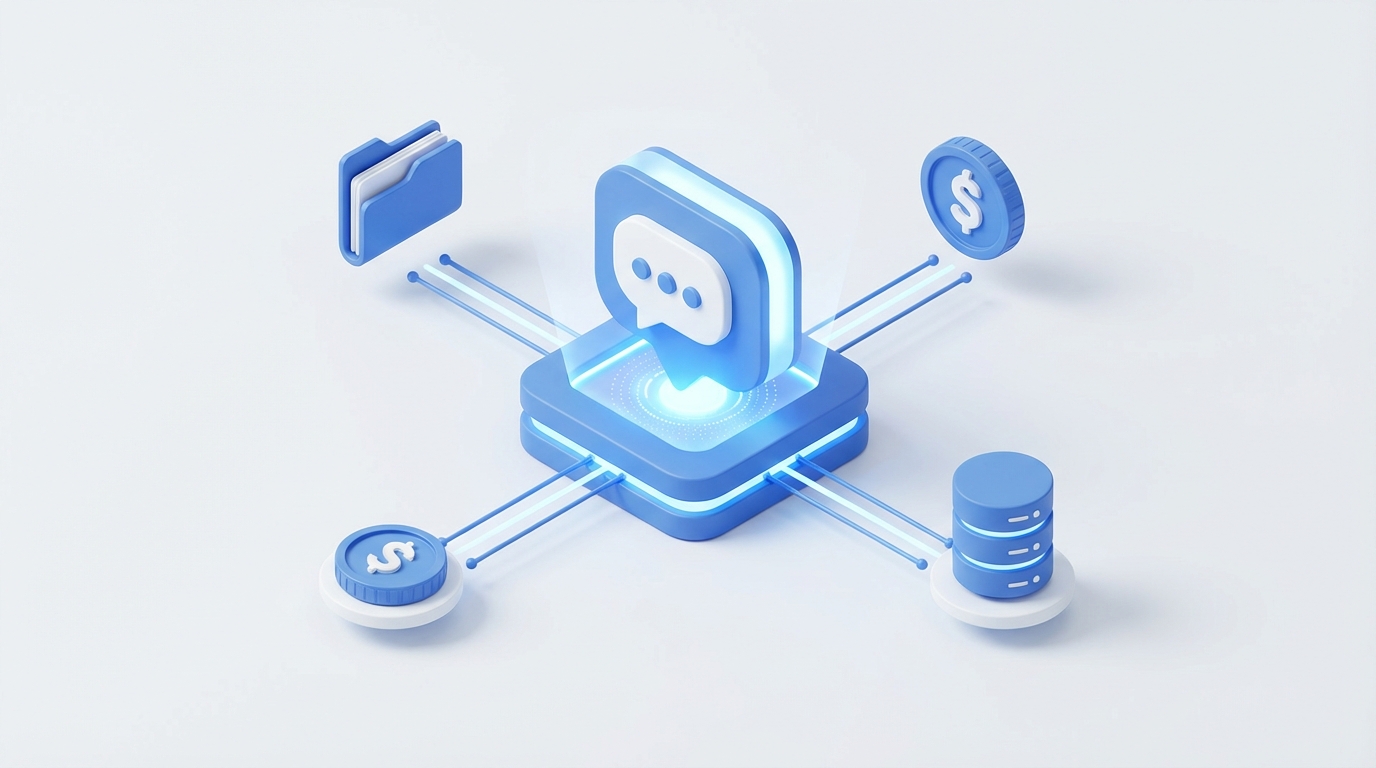
We flip this model. We bring the work to the Command Centre.
For 90% of modern businesses, the Command Centre is either Slack or Microsoft Teams. This is where your staff live. It is where they chat, share jokes, and collaborate.
By using APIs (Application Programming Interfaces), we can turn Slack from a chat room into an operating system.
Your staff doesn't need to know how to use the database. They just need to know how to send a text message.
2. The Real-World Example: The "One-Click" Onboard
Let’s look at a manual process that plagues almost every service business: Client Onboarding.
The Old Way (The Manual Grind):
Your Sales Manager closes a deal. To onboard that client, they have to:
- Open the CRM and update the status. (5 mins)
- Open QuickBooks/Xero to create the customer profile. (5 mins)
- Open Google Drive, create a folder, and copy the template sub-folders. (5 mins)
- Open Slack, create a new channel, and invite the team. (2 mins)
- Email the team to say "New client is signed!" (3 mins)
Total Time: 20 minutes per client.
The Risk: High. What if they forget to create the Google Drive folder? The Ops team has nowhere to store files. Chaos ensues.
The New Way (The Invisible Interface):
We build an automation that lives inside Slack.
The Sales Manager types a simple command into a private channel:
s/onboard-client [Client Name] [Contact Email]
That is it.
Behind the scenes, the automation wakes up and executes the logic:
- Database: It logs the client in your CRM.
- Finance: It adds them to QuickBooks automatically.
- Storage: It creates the Google Drive folder structure.
- Communication: It creates the Slack channel #client-[name].
- Notification: It posts a message in the #general channel: ":tada: New Client Signed! All systems prepped."
Total Time: 15 seconds.
Training Required: None. If they can send a WhatsApp, they can run this system.
3. The Math: Why "Small" Time Savings Create Huge Wealth
You might look at that example and think: "It only saves 20 minutes. Is it worth it?"
Let's look at the cold, hard numbers for a growing agency onboarding 5 clients a week.
The Time Calculation:
- Manual: 20 mins x 5 clients = 1.6 hours/week.
- Annual Cost: 1.6 hours x 48 working weeks = 76.8 hours a year.
At a fully loaded management cost of £40/hour, that is £3,072 spent just on admin setup.
But that isn't the real cost.
The real cost is the Efficiency Multiplier.
When that Sales Manager has to stop selling for 20 minutes to do data entry, they lose momentum. They don't make the next call.
Furthermore, we remove the Error Rate.
If a human does this process 250 times a year, they will make a mistake 2-5% of the time.
- Maybe they misspell the email in QuickBooks (Invoice bounces -> Cash flow delay).
- Maybe they forget the Google Drive folder (Ops team wastes 1 hour looking for files).
If just one of those errors delays an invoice payment of £10,000 by a week, the cost of the manual process skyrockets.
Summary: Software Should Serve Humans, Not the Other Way Around
Your team is not "non-technical." They are just busy.
They don't want to learn another login. They don't want another dashboard.
By connecting the tools you already have—Slack, Google Workspace, QuickBooks—we can build complex, powerful workflows that feel like magic.
You don't need to hire new staff. You don't need to pay for expensive training seminars. You just need to connect the pipes.
The result?
- Zero Learning Curve.
- 100% Data Accuracy.
- Instant Adoption.
Are you tired of buying software that your team refuses to use? Let us show you how to build "Invisible" automations inside the tools you already own. In our AI Opportunity Audit, we map your software stack and show you exactly where the connections are missing.
Stop training. Start automating. Book your Audit here:https://aideal.group/advisory/audit