
Every UK business owner has heard the promise by now: Artificial Intelligence and automation can cut your operating costs, increase your margins, and allow you to serve more customers without hiring proportionally more staff.
The case studies are compelling. A logistics firm reduces admin time by 60%. A recruitment agency doubles its placement capacity with the same headcount. A facilities management company cuts invoice processing time from days to minutes.
If you run an SMB turning over £1m–£5m, you are probably wondering when you will see these results in your business.
Here is the uncomfortable truth: You might never see them.
Not because the technology doesn't work. Not because you lack the budget. But because of something most business owners don't even realise is broken: your data.
The businesses winning with AI right now aren't necessarily the most tech-savvy. They are the ones who, often unknowingly, built their operations on a solid data foundation. The businesses struggling with automation—despite spending thousands on software—are the ones operating on fragmented, inconsistent, and patchy data.
If your customer information lives in three different places. If your sales team and your accounts team record the same data differently. If you cannot answer the question "How many active clients do we have?" without spending an hour reconciling spreadsheets...
You have a data problem. And it is costing you more than you think.
The Age of the "Data Dividend"
We are entering an era where businesses with clean, structured, and accessible data will operate like modern factories, while those without will operate like medieval workshops.
Let me be specific about what is at stake.
The Businesses That Win:
- They can instantly see which customers are profitable and which are draining resources.
- They can predict cash flow problems before they happen and take action.
- They can automate repetitive tasks because their systems "speak the same language."
- They can scale revenue without proportionally increasing headcount.
The Businesses That Lose:
- They spend hours creating reports that should take seconds.
- They make strategic decisions based on "gut feel" because they cannot trust their data.
- They buy expensive software that sits unused because it cannot integrate with their existing mess.
- They watch competitors serve more customers, faster, with fewer staff—and don't understand why.
This isn't hyperbole. I have seen businesses spend £15,000 on a CRM implementation, only to abandon it six months later because "it didn't work." The CRM wasn't the problem. The problem was that half the customer data was still in Excel, a quarter was in the old system, and the rest was in peoples' heads.
You cannot automate chaos. You can only amplify it.
The "Fragmented Data" Tax
Most SMB owners don't realise they have a data problem because the pain is diffuse. It doesn't show up as a line item on your P&L. It manifests as:
- Sarah in Sales spending 20 minutes searching for a client's previous quote because it was saved in someone else's email.
- Your accountant asking you the same questions every month because the information isn't consistently recorded.
- Missed opportunities because a lead enquired twice, but no one realised they were the same person (different email addresses, slightly different company name).
- Frustration when you try to implement a "simple" automation and discover that your invoice numbers don't match between your CRM and your accounting software.
These aren't technology problems. They are data architecture problems.
And here is the kicker: The longer you wait to fix this, the more expensive it becomes.
Every day you operate with fragmented data, you are creating more fragmented data. The hole gets deeper.
How to Build Your Data Foundation (5 Practical Steps)
The good news is that you don't need to hire a Chief Data Officer or invest in enterprise-grade infrastructure. You just need to implement five straightforward principles that Fortune 500 companies have been using for decades—scaled down for the realities of an SMB.
1. Establish a "Single Source of Truth" for Each Data Type
This is the most important principle, and the one most businesses violate constantly.
The Rule: Every type of data (customers, invoices, inventory, projects) should have one authoritative home. Not two. Not three. One.
In Practice:
- Your CRM is the source of truth for customer contact information. Full stop.
- Your accounting software (Xero, QuickBooks, Sage) is the source of truth for financial transactions.
- Your project management tool is the source of truth for task status and deadlines.
If someone asks, "What is the client's phone number?" there should be one place to look. Not "Check the CRM, or maybe it's in the spreadsheet, or Dave might have it in his notebook."
How to Implement This:
Pick your existing software as the "master" for each data category. If you don't have software for a category (e.g., you track projects in email), now is the time to choose one. It doesn't have to be expensive—free tiers of tools like Notion or Airtable can suffice.
Then, make it a company policy: "If it's not in [System Name], it doesn't exist."
2. Stop Garbage at the Gate (Data Validation)
Most data problems are created at the point of entry. Someone types "Vodafone PLC" one time, "Vodafone plc" another time, and "Vodafone - UK" a third time. Now your system thinks you have three different clients named Vodafone.
The Rule: Make it harder to enter bad data than good data.
In Practice:
Use drop-down menus, required fields, and format rules to prevent inconsistency before it starts.
- Don't let people type in a customer name if that customer already exists—force them to select from a list.
- Make phone numbers auto-format (e.g.,
07123 456789not07123456789or+44 7123 456789). - Use standardised options for fields like "Customer Type" (don't let one person write "SME" and another write "Small Business").
How to Implement This:
Spend an afternoon configuring your CRM or main database. Most modern software allows you to create dropdown lists, mandatory fields, and validation rules without any coding. If your current software doesn't support this, it might be time to switch.
This single change will prevent more future problems than any other action on this list.
3. The Monthly "Data Audit" Ritual
Data degrades over time. Clients change phone numbers. Companies get acquired and rename themselves. People leave jobs, and their email addresses bounce.
If you only clean your data when something breaks, you are already too late.
The Rule: Schedule a recurring monthly task to review and clean your core data.
In Practice:
Block out 1–2 hours on the first Monday of every month. During this session:
- Look for duplicate records (same client entered twice).
- Check for incomplete records (missing phone numbers, no assigned salesperson).
- Update any records flagged as "incorrect" by your team during the month.
- Archive old data that is no longer relevant (e.g., leads from 3 years ago who never converted).
How to Implement This:
Most CRMs and databases have built-in tools to flag duplicates and incomplete records. In Zoho CRM, for example, you can run a "Duplicate Check" in seconds. In Excel or Google Sheets, use "Conditional Formatting" to highlight blanks.
Assign this task to one person. Don't make it "everyone's responsibility," or it will be no one's responsibility.
4. Create a "Company Data Dictionary"
Here is a test: Ask three people in your business, "What counts as an active client?"
If you get three different answers, you have a problem.
Ambiguity in definitions creates inconsistency in data. One person marks a client as "Active" when they have an open project. Another marks them "Active" if they have purchased in the last 12 months. Your reports are now useless because you are comparing apples to oranges.
The Rule: Write down how your business defines key terms, and make sure everyone uses the same definitions.
In Practice:
Create a simple document (Google Doc, Notion page, or even a printed sheet on the wall) that defines:
- What is an "Active" vs "Inactive" client?
- What is a "Lead" vs a "Prospect" vs an "Opportunity"?
- How do we name files? (e.g.,
ClientName_ProjectName_Date.pdf) - How do we format dates? (UK standard:
DD/MM/YYYY)
How to Implement This:
Start with the 5–10 most commonly confused terms in your business. Write one-sentence definitions. Share it with the team. Update it whenever confusion arises.
This isn't bureaucracy. It's the difference between a team that speaks the same language and a team that doesn't.
5. Integrate, Don't Duplicate
The fastest way to create data chaos is to enter the same information into multiple systems manually.
When Sarah the salesperson closes a deal, she shouldn't have to:
- Update the CRM.
- Email Accounts to raise an invoice.
- Enter the client into the project management tool.
- Update the revenue forecast spreadsheet.
Every manual re-entry is an opportunity for error, delay, and inconsistency.
The Rule: If two systems need the same data, connect them. Don't copy-paste.
In Practice:
Modern software is designed to talk to other software. Your CRM can automatically push new clients into your accounting software. Your project management tool can pull data from your CRM. Your invoicing software can update your revenue tracker.
These connections are called "integrations," and they are often easier to set up than you think. Tools like Zapier, Make (formerly Integromat), or n8n can connect almost any two systems without requiring a developer.
How to Implement This:
Identify the biggest "double-entry" pain point in your business. (Ask your team: "What information do you enter in more than one place?") Then, research whether an integration exists between those two systems.
If it does, invest an hour to set it up. If it doesn't, consider whether one of your tools should be replaced with something more integration-friendly.
The Foundation Comes First
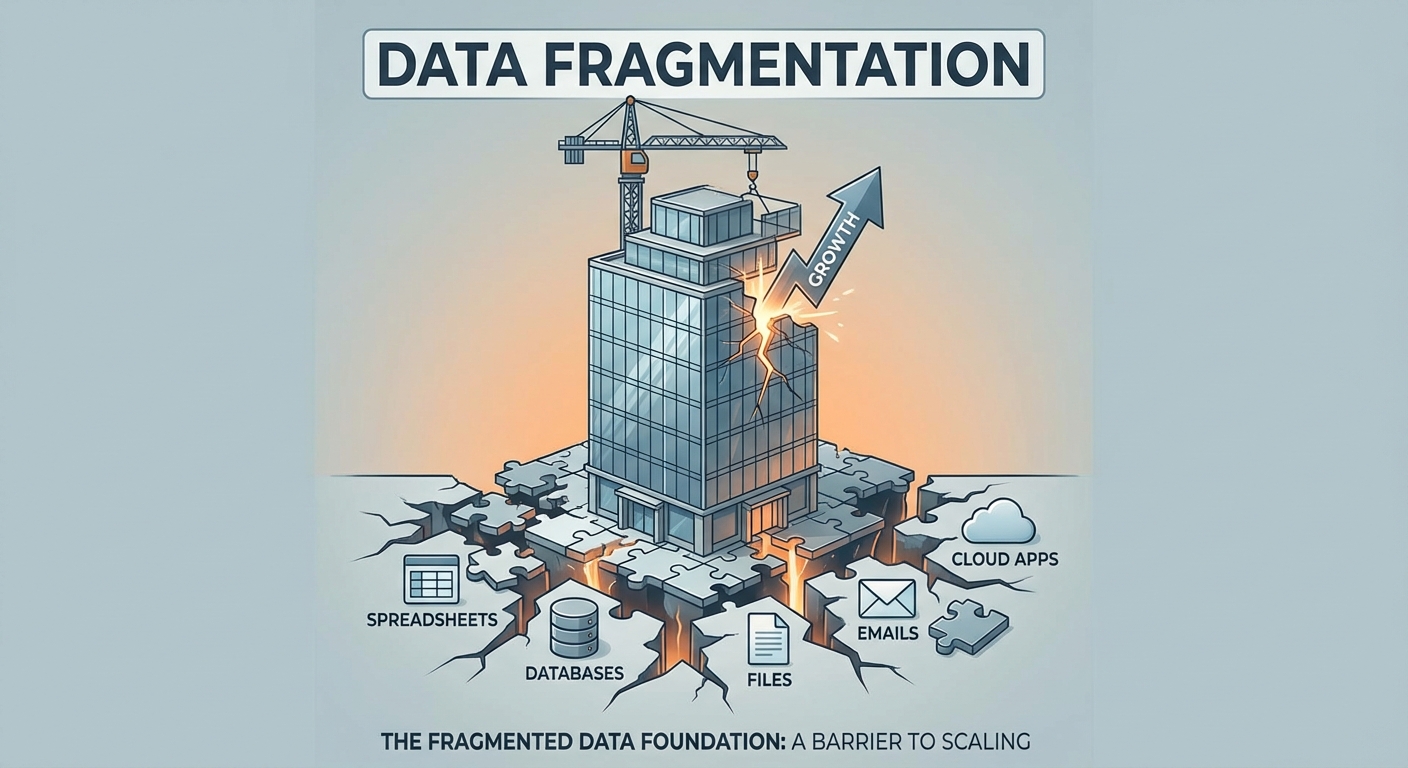
There is a reason why construction companies spend weeks laying foundations before putting up walls. A beautiful building on a weak foundation will crack and collapse.
Automation is no different.
You can have the best AI tools, the most expensive CRM, and the cleverest workflow software in the world. But if your data is fragmented, patchy, and inconsistent, none of it will deliver the results you are paying for.
The businesses that will dominate the next five years are not the ones with the flashiest technology. They are the ones that quietly, methodically built a data foundation strong enough to support everything they want to build on top of it.
The question is: Are you one of them?
If you want to understand the current state of your data architecture—and what it would take to fix it—we have created a specific diagnostic process for exactly this problem. Our FREE AI Opportunity Audit includes a full data infrastructure review, with a clear roadmap of what needs to be fixed before you invest another pound in software or automation.
*Stop building on sand. Book your free Audit here: https://aideal.group/