
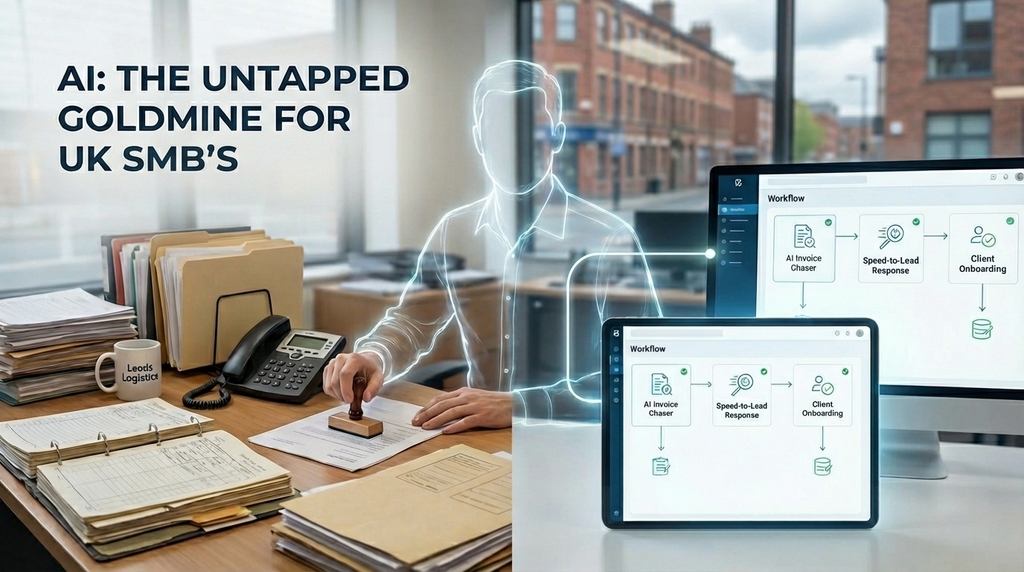
There is a dangerous myth circulating in the UK business community: that Artificial Intelligence is a luxury reserved for tech startups and Fortune 500 companies.
If you run a logistics firm in Leeds, a recruitment agency in Bristol, or a facilities management company in Manchester, you might think AI is irrelevant to you. You might look at your current operations—reliant on email chains, PDFs, and manual data entry—and think you lack the "digital DNA" to automate.
You would be wrong.
In fact, traditional businesses have more to gain from automation than tech companies do. Here is why your "boring," repeatable processes are actually a goldmine waiting to be tapped—and how you can do it without hiring a single developer.
The "High-Tech" Trap
We tend to associate AI with "Innovation" with a capital I. We think of self-driving cars or software that writes poetry.
But for a business turning over £1m–£5m, "Innovation" isn't the goal. Efficiency is.
Tech startups are often chaotic. They pivot their business model every six months. They are constantly breaking things to move fast. It is actually incredibly difficult to automate a business that changes every week. You cannot build a system on shifting sand.
Traditional businesses are different.
If you sell construction supplies, your process likely hasn't changed fundamentally in ten years:
- Customer requests a quote.
- Team calculates costs and sends quote.
- Customer accepts.
- Invoice is sent.
- Goods are delivered.
Because your business is stable, logical, and repeatable, it is perfect for automation. You don't need a team of data scientists; you just need to connect the dots.
Enter "The Invisible Employee"
The best way to think about AI and Automation in a traditional setting is not as a "Robot Overlord," but as an Invisible Employee.
Imagine you hired a new admin assistant.
- They work 24 hours a day, 7 days a week.
- They never make a typo.
- They never forget to follow up on an email.
- They cost a fraction of a minimum wage salary.
This "employee" doesn't need to reinvent the wheel. They just need to handle the tasks your high-value human staff are currently wasting their time on.
Here are three examples of how "non-tech" businesses are using this today.
1. The Automated Chaser (Cash Flow)
The Old Way: Your accounts manager spends Friday morning manually checking Xero or QuickBooks to see who hasn't paid, then writing awkward emails to chase invoices.
The New Way: An automation watches your accounting software. When an invoice becomes 3 days overdue, it automatically drafts and sends a polite reminder email. If it hits 7 days, it sends a firmer email and notifies your accounts manager via a Slack message or SMS to give them a call.
Result: Better cash flow, less awkwardness, and hours saved.
2. The "Speed-to-Lead" responder (Sales)
The Old Way: A potential client fills out a form on your website on a Saturday. By the time your sales team gets to the office on Monday morning, the lead has gone cold or hired a competitor.
The New Way: The form submission triggers an instant AI workflow. The lead gets a personalised WhatsApp or Email immediately: "Hi John, thanks for the enquiry. I’m reviewing your details now. When is the best time for a 5-minute chat on Monday?" The lead is then automatically entered into your CRM.
Result: You capture the customer while their intent is highest.
3. The Onboarding Machine (Operations)
The Old Way: You sign a new client. Now you have to manually create a Google Drive folder, draft a contract, send a welcome email, and set up the project in your project management tool.
The New Way: You click one button marked "Client Won." The automation creates the folders, generates the contract, sends the welcome pack, and assigns tasks to your team.
Result: A professional first impression every time, with zero admin effort.
The "Low-Tech" Implementation Protocol
So, if you are convinced that this applies to you, how do you start without getting overwhelmed?
The mistake most SMBs make is trying to automate everything at once. They buy expensive software suites they don't understand and end up frustrated.
Instead, follow the "10% Rule."
Look at your business. Identify the tasks that consume the bottom 10% of your team's cognitive energy. The copy-pasting. The data entry. The scheduling.
Don't try to replace your staff. Replace the tasks that your staff hate doing.
- Map it: Write down the exact steps of a single process on a piece of paper.
- Simplify it: Remove any steps that aren't necessary.
- Automate it: Use tools that bridge the gap between your current software.
Summary: Evolution, Not Revolution
You do not need to become a "tech company." You do not need to change your business model.
By implementing these tools, you are simply modernising your infrastructure. It is no different than when businesses moved from typewriters to word processors, or from Rolodexes to CRMs.
The businesses that thrive in the next five years won't be the ones with the flashiest AI. They will be the traditional businesses that quietly, efficiently, and profitably used automation to do more with less.
If you are looking to map out your first process, we have created a library of free educational materials and blueprints specifically for businesses like yours. You can access them for free at the A.Ideal Academy [https://aideal.group/academy].