
If you ask five different consultants how to calculate the ROI (Return on Investment) of Artificial Intelligence, you will likely get five different answers.
They will talk about "intangible benefits," "future-proofing," and "digital transformation."
For a UK business owner turning over £2m, these are just buzzwords. You cannot pay your staff with "intangible benefits." You cannot pay your Corporation Tax with "digital transformation."
The hesitation many SMB owners feel regarding AI isn’t a fear of technology; it is a fear of wasting money. You are rightfully asking: "If I spend £5,000 implementing this system, when do I see that money back?"
The good news is that you don't need a degree in data science to answer that. You just need a calculator.
Evaluating the financial impact of automation is not magic. It is simple arithmetic. Here is the exact framework we use to quantify the value of a project before we write a single line of code.
1. The Lie of the "Hourly Rate"
To understand what manual processes are costing you, you first need to be honest about what your human team costs.
Most business owners look at an employee on £35,000 a year and calculate their hourly cost based on that gross salary.
This is the first mistake.
Your actual cost includes Employer’s National Insurance, pension contributions, software licences, equipment, office overheads, and management time. A staff member with a £35k salary actually costs the business closer to £45k–£50k per year.
Furthermore, no human works 8 hours a day. Between coffee breaks, meetings, and context switching, the average "productive" time is often around 5-6 hours.
The Math:
If a "fully loaded" employee costs you £50,000 and works 1,600 productive hours a year, their time is worth roughly £31.25 per hour.
Every time that employee spends one hour copy-pasting data from an email into a spreadsheet, you aren't just losing time. You are effectively burning a £30 note.
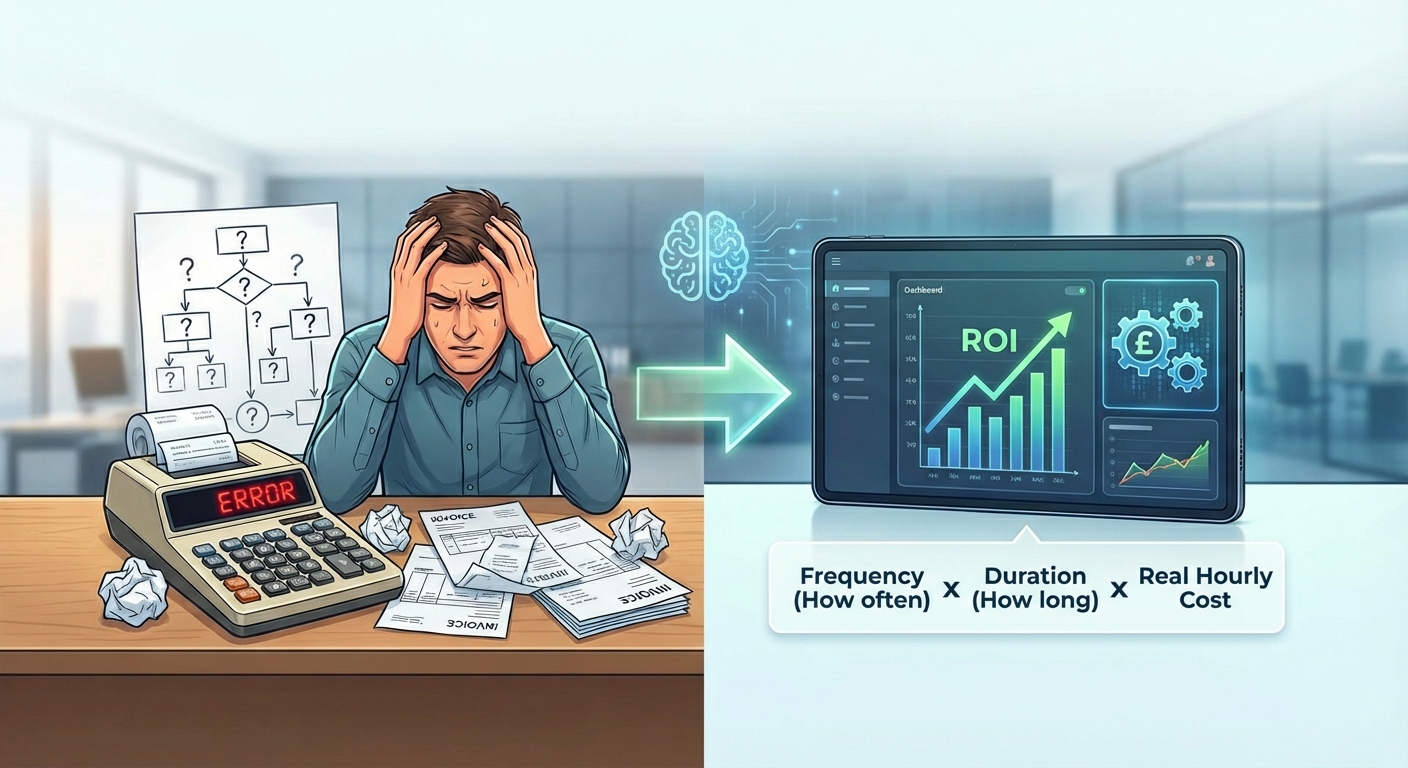
2. The "Frequency x Duration" Formula
Once you know the Real Hourly Cost, you need to identify the "Silent Killers." These are small tasks that seem insignificant in isolation but are devastating in aggregate.
We use a simple formula:
Frequency (How often) x Duration (How long) x Real Hourly Cost.
Let’s take an example from the logistics sector:
Their Sales Admin, let’s call her Sarah, spent 5 minutes manually entering details from a "Request a Quote" form into their CRM and drafting a reply.
- Frequency: 15 leads a day.
- Duration: 5 minutes per lead (1.25 hours/day).
- The Cost: 1.25 hours x £31.25 = £39.06 per day.
That doesn’t sound like much until you zoom out.
£39 a day is £195 a week.
£195 a week is £9,360 a year.
The Reality Check:
You are currently paying nearly £10,000 a year just to move data from a website to a CRM.
But here is the scary part: This is just one task, for one employee, in one department.
Your business is likely riddled with dozens of these "5-minute" leaks. The accounts team matching invoices. The operations team scheduling drivers. The HR team onboarding staff. When you add them up, the "Silent Tax" you are paying for manual work isn't £10,000—it is likely closer to £50,000 or £100,000.
If it cost £5,000 to build a system that solved just this one specific problem instantly, 24/7, forever—you would make your money back in just over six months. After that, it is pure profit.
3. The "Capacity" Multiplier (The Real ROI)
The calculation above covers Cost Savings, but for a growing SMB, the real gold is in Capacity Expansion.
Most businesses between £500k and £5m in revenue hit a "ceiling." To take on more clients, they have to hire more staff. This keeps margins thin.
Automation allows you to break that link.
Let’s go back to Sarah. If we automate that data entry, we don't fire Sarah. We don't want to lose good people. Instead, we give Sarah back 1.25 hours of her day (over 6 hours a week).
What is the financial impact if Sarah spends those 6 hours calling the leads immediately (Speed-to-Lead) instead of doing data entry?
- If she closes just one extra deal a month because she is faster and more focused, and your Lifetime Customer Value (LTV) is £5,000...
- That is £60,000 in new revenue per year.
The Total Audit Equation:
£9,360 (Admin Savings) + £60,000 (New Revenue) = £69,360 Annual Impact.
Suddenly, the "risk" of investing in AI & Automation disappears. The real risk is not doing it.
How to Run Your Own "Mini-Audit"
You don’t need to overhaul your whole business overnight. You can run this diagnostic on a single department today.
- Identify the "Grunt Work": Ask your team: "What is the one task you do every day that you hate the most?" It is usually data entry, scheduling, or chasing invoices.
- Time It: Don't guess. Watch them do it. If it takes 5 minutes, write down 5 minutes.
- Count It: How many times a week does it happen?
- Cost It: Use the £30/hour rule of thumb (or calculate your own).
If the annual cost of that problem is higher than £5,000, it is a prime candidate for automation.
Summary: It’s Just Engineering
We need to stop treating AI like a magic wand and start treating it like industrial machinery.
If you ran a factory, and you could buy a machine for £10,000 that saved you £50,000 a year in raw materials, you wouldn't hesitate. You would buy it immediately.
Software automation is exactly the same. It is an asset that reduces your operating costs and increases your production capacity.
The companies that win in this economy won't be the ones dazzled by the hype. They will be the ones who did the math, realised the cost of inaction was too high, and built the systems to scale.
If you want to see the numbers for your specific business, we can help. We conduct a specific AI Opportunity Audit where we map your processes, run the math, and present you with a clear "Cost vs. Benefit" analysis before you commit to anything.
Stop guessing and start calculating. Book your Audit here: https://aideal.group/advisory/audit